Cart
0
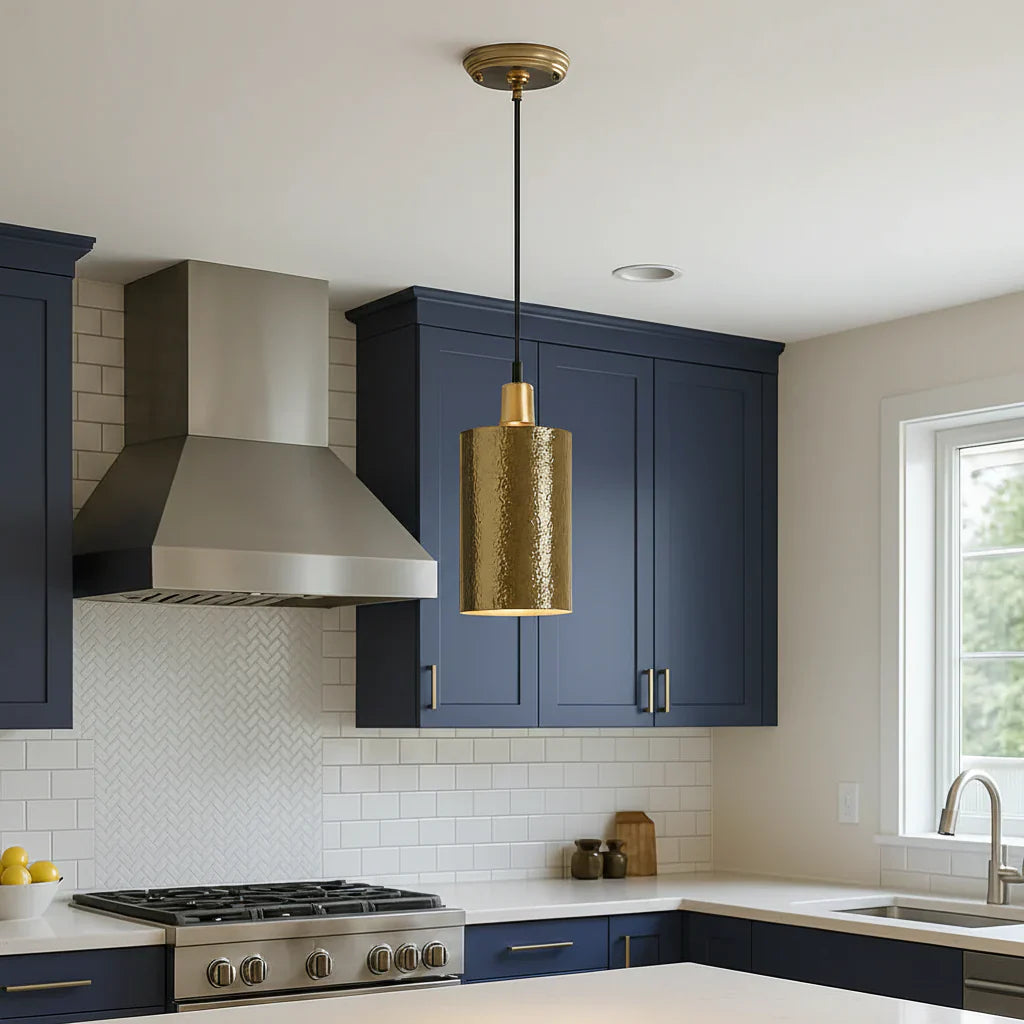
Unlacquered brass pendant lights are having a moment in American kitchens — and unlike most trends, this one is built on something real. Because the brass carries no protective lacquer, every fixture slowly develops its own patina, turning from bright gold to warm honey and amber tones over months and years. No two end up alike. In this guide we cover how the living finish works, how to size and hang a pendant, and how to choose between brass and copper for your space.
What does "unlacquered" actually mean?
Most brass lighting sold today is coated with a clear lacquer that locks in the shiny factory finish. Unlacquered brass skips that coating entirely. The raw metal is exposed to air, humidity, and touch, so it oxidizes naturally — a process called developing a patina. The fixture starts bright and golden, then gradually deepens into muted honey, amber, and eventually rich brown tones with darker accents where hands touch it most.
This is why designers call it a living finish: it keeps changing, and it tells the story of your home. It is also why unlacquered brass fixtures pair so naturally with vintage, farmhouse, French-country, and Mediterranean interiors.
How long does the patina take to develop?
Indoors, expect the first visible warming within 2 to 3 months. A noticeable honey tone usually settles in around 6 to 12 months, and the deep antique character develops over several years. Kitchens tend to age brass faster than bedrooms because of humidity and cooking vapors — which is exactly where pendant lights shine.
Prefer the bright golden look? You are never locked in. A soft cloth and any standard brass polish restore the original shine in minutes, and the patina simply begins again.
Are unlacquered brass pendant lights hard to maintain?
No — the honest answer is that the best maintenance is none at all. The patina is not damage; it is the finish doing what it is designed to do. Day to day, an occasional dusting with a dry cloth is all a pendant needs. Avoid harsh chemical cleaners, which can strip the developing patina unevenly. If you ever want a reset, polish the fixture and let it start aging fresh.
How do I size a pendant light for my kitchen?
Three rules of thumb cover most situations:
- Over a kitchen island: use pendants 10"–14" wide, spaced 24"–30" apart, with the bottom of the fixture 30"–36" above the countertop.
- Over a sink or counter run: a single 8"–12" pendant hung 30"–34" above the surface works well.
- Over a dining table: go larger — 14"–18" wide — centered with the bottom 30"–34" above the tabletop.
Handcrafted fixtures like ours are made to order, so custom diameters and cord lengths are available if your space falls outside these ranges.
Do handmade brass fixtures work with US wiring?
Yes. Quality handcrafted pendants use standard E26/E27 sockets, which accept common US screw-in bulbs, including dimmable LEDs. Installation is the same as any hardwired pendant: they connect to a standard US junction box, and any licensed electrician can hang one in under an hour. Adjustable cord or chain lengths make it easy to fine-tune the drop height.
Brass or copper — which should you choose?
Both are living finishes, but they age differently. Unlacquered brass moves from bright gold toward warm honey and amber. Copper starts salmon-pink and deepens toward russet and chocolate brown, often faster than brass. Hammered copper adds texture that catches light beautifully in kitchens.
A simple guide: choose brass pendant lights if your hardware (faucets, cabinet pulls) is brass or gold-toned; choose copper if you are pairing with copper cookware, a copper sink, or darker cabinetry. Mixing the two also works — both belong to the same warm-metal family.
Our handcrafted pendant collection
Every fixture at The House of Brass is handmade by artisans in Morocco from solid brass or copper — no plating, no lacquer, no shortcuts. A few favorites:
- Unlacquered Brass Pendant Light – Round Dome — a full dome silhouette that develops a golden patina; custom sizes available.
- Unlacquered Brass Cylinder Pendant — clean, minimal lines in solid brass, dimmable, sizes 8"–14".
- Hammered Copper Pendant – Aged Patina — hand-hammered texture in four sizes with adjustable cord.
- Hand-Hammered Copper Dome Pendant — a statement dome in solid copper that deepens in color over time.
Browse the full pendant light collection — every piece ships free worldwide with a 5-year warranty, and custom sizes are always available.
Frequently asked questions
Will unlacquered brass turn green?
Indoors, no. The green verdigris you see on old rooftops comes from decades of rain exposure. Indoor brass develops warm brown and amber tones, not green.
Can I speed up the patina?
Yes — simply handling the fixture more, or living in a more humid climate, accelerates it naturally. Some owners apply patina solutions for instant aging, but we recommend letting it develop on its own for the most even, authentic result.
Are these fixtures solid brass or brass-plated?
Ours are 100% solid brass. Plated fixtures cannot develop a true patina — the thin coating wears through to the base metal instead. If a "brass" light is unusually cheap or lightweight, it is almost certainly plated.
Do you make custom sizes?
Yes. Because every fixture is made to order in our workshop, custom diameters, cord lengths, and finishes are available — contact us with your dimensions.